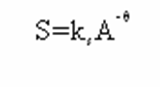
Rivers tend to erode or aggrade their bed and, barring any recent climate or tectonic influences, will form a stable longitudinal profile. This profile will grade to a base level. Sea level or a main-stem river, in the case of a tributary, can set this base level. The profile can be approximated by the an empirical power-law equation that relates the slope at any given point to the upstream contributing drainage basin area
where ks is a steepness index and θ is the concavity. Although this relationship is based on empirical evidence, physical reasons for this correlation can be made. For example, the upstream contributing drainage area will contribute to river discharge. As the drainage area increases downstream, so will discharge which enhances stream power and the capacity for a river to incise. This increase in discharge also allows the river to carry the same amount of sediment with a lower gradient.
If a change in climate or tectonic event does change the relationship between a river and its base level, the river will respond by forming a new equilibrium profile. This is depicted in the figure below showing an initial, transient, and final profile of a uniformly uplifted stream that grades to a constant base level
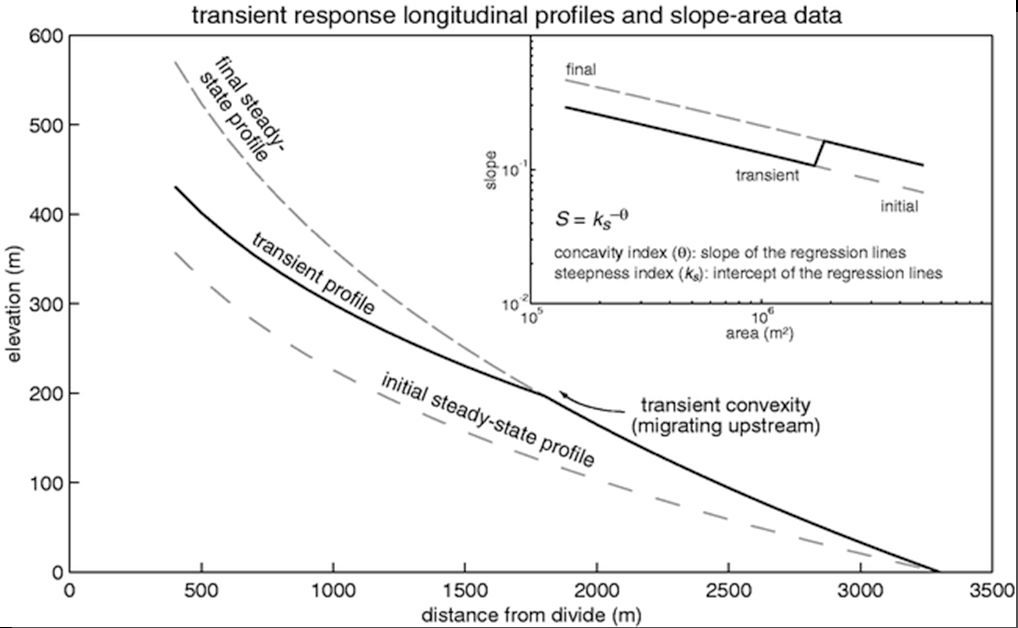 (Snyder et al., 2000)
The sharp change in slope found in the middle of the transient profile is termed a knickpoint. Downstream of the knickpoint, the stream has or is responding to the uplift by incising to it’s new equilibrium profile. Upstream of this point, the stream has not yet begun to “feel” the effects of the uplift and therefore will maintain its previous profile until the knickpoint migrates upstream.
Many 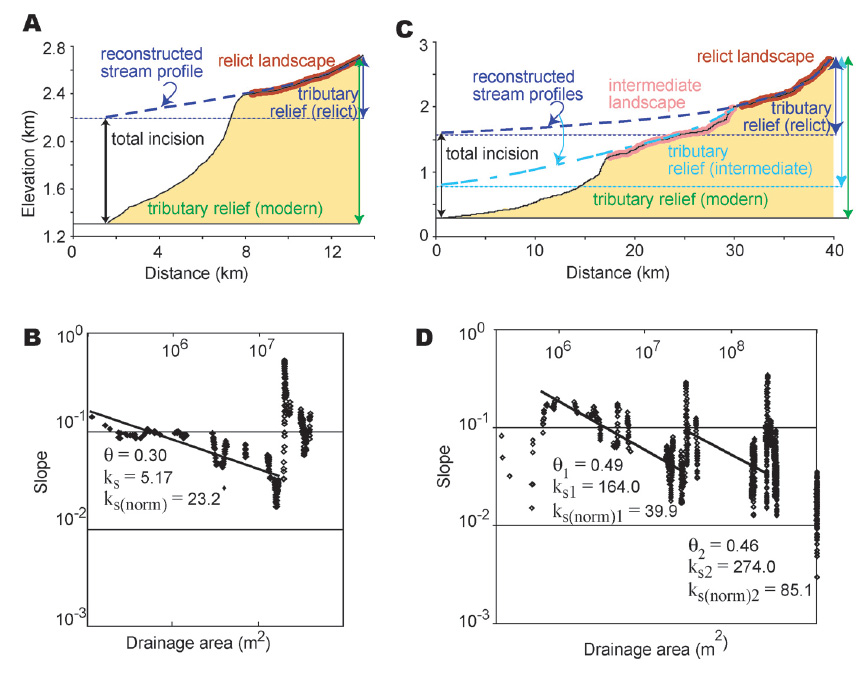
This was further shown in their figure below
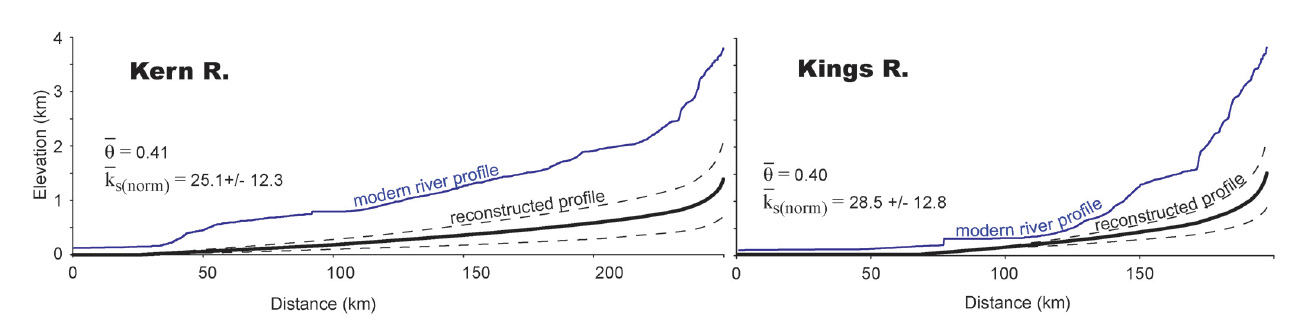
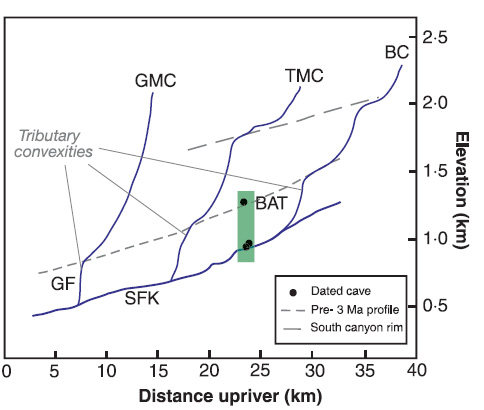
Stock et al., 2005 showed that the extrapolated reconstructed profile matched with a cave that marked the begining of increased incision rates. The Bat cave was dated at 2.7 Ma. For more information on this work and how that date was estimated, see the section on cosmogenic nuclides.