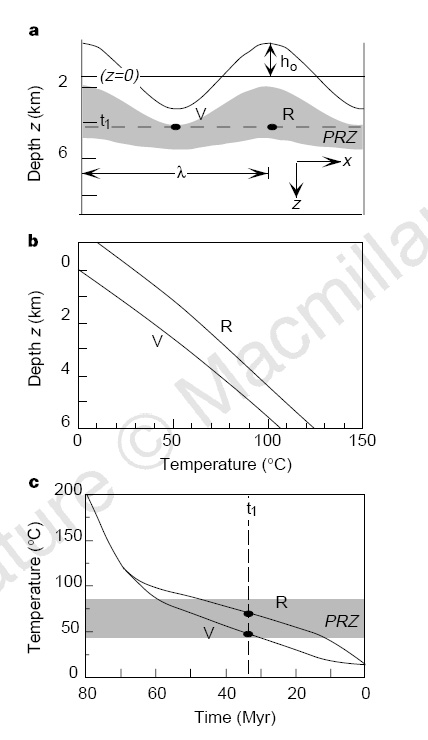
Certain minerals have an affinity to incorporate different elements into their crystalline structure. Of particular geological significance is the affinity for some minerals to trap radiogenic elements, such as Uranium. Past methods have measured the damage the decay of these elements do to the crystalline structure to estimate the thermochronological history of the mineral. Other means of estimating this history is by measuring the “trapping” of the nuclear reaction’s daughter products within the mineral. For example, when Uranium decays to Thorium, a Helium byproduct is released. If the mineral is warm (over 70 degrees C), the He atom escapes the crystalline structure. As the mineral cools below 70 C, the He atom is trapped in the crystalline structure. By also measuring the concentrations of U/Th, one can deduce the time since the mineral cooled below 70 C. If in addition to these measurements, you can accurately reproduce the geotherm below the sample, a long-term rate of exhumation can be estimated.
This methodology has been used in the
The age of a mineral under a valley will appear older than the age under an interfluve since the 70 C isotherm mimics topography. By measuring the U/Th-He concentrations along a 200km long transect parallel to the strike of the range and fixing the U/Th-He ages for elevation, House et al. showed a correlation between modern topography and the very old estimates of U/Th-He ages.

This was interpreted as requiring the shape of the modern topography (canyon and interfluves) to have been created 70-80 Ma. By looking at long-term exhumation rates, they estimated paleorelief to be ~3km at this time. An analogy to the modern

Jones et al., 2004 also showed that this thermochronological data is highly dependent on the plutonic heat production.
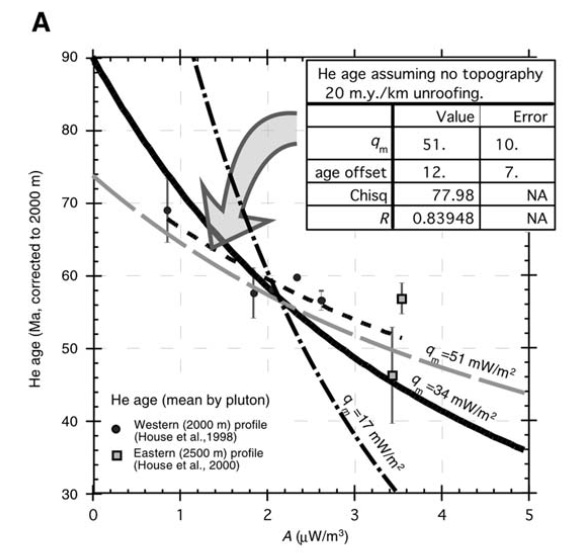
While House et al., 1998 sampled varying lithologies (and thus variable heat production values), Clark et al., 2005 tried to sample similar geology. By sampling similar lithologies, they were able to reduce some of the uncertainty related to estimating the subsurface geotherm, which can be problematic in a cold area with varying concentrations of heat producing elements.