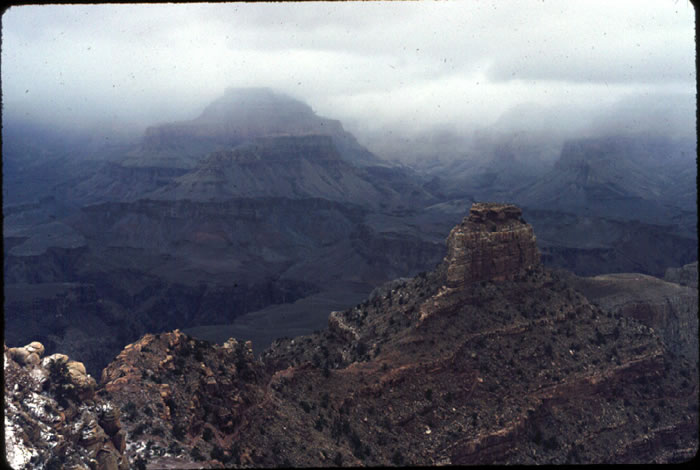
Paleozoic rocks of the Grand Canyon from the South Kaibab Trail. The Cambrian Tapeats Sandstone, on the edge of the inner gorge at left, is overlain by the slope-forming Cambrian Bright Angel Shale, which is turn is overlain by (in order) the Cambrian Muav Limestone, the Mississippian Redwall Limestone, the Pennsylvanian and Permian Supai Group, and the Permian Coconino Sandstone. The Proterozoic Vishnu Schist is hiding in the inner gorge of the canyon. The bottom three units record the major transgression of the ocean over western North America; the top units were deposited when the Ancestral Rocky Mountains were formed. The canyon itself is Tertiary in age, though whether extremely young (post 10 Ma) or middle Tertiary is still disputed.