Mojavia*

The western United States was part of the continent Laurentia during the Precambrian. Laurentia was assembled fromprovinces accreting to the Archaen craton in the Proterozoic; the Yavapai, Mazatzal, Grenville, Wyoming, and Mojavia provinces. The crustal provinces were determined using Nd crustal model ages. The province of Mojavia was first identified by Bennet and Depaulo(1987), from the distinct Nd crustal model age and Precambrian lithology which differ from the neighboring provinces. The crustal ages for Mojavia are around 2.0-2.3Ga. The ages of Yavapai and Mazaztal provinces are2.1-2.6 Ga and 1.7-1.8Ga respectively (Bennet and Depaulo, 1987). The Mojavia province is primarily composed of metamorphic sedimentary rocks while the Yavapai and Mazatzal provinces are mostly volcanic rocks (Bryant et al., 2001).
Geology of Mojavia:
The Precambrian rocks in California and western Arizona can be described as layered gneisses, foliated plutons, and anorogenic plutons. The general lithology of Mojavian rocks are metamoprhic sedimentary rocks (such as quartzites, pelites, and schists), with a few volcanics (Bennett and DePaulo, 1987; Condie, 1992; Anderson et al., 1993). This differs greatly from the YAvapai and Mazatzal provinces which are composed mostly of plutonic and volcanic supracrustal rocks. Outcrops can be found in the Homer, Hualapai, Mohave, Whipple, Old Woman, Piute, Turtle, Newerry, Marble, Bill Williams, New York, McCullough, Dead, and Ivanpah mountains (Bennett and DePaulo, 1987; Anderson et al., 1993).
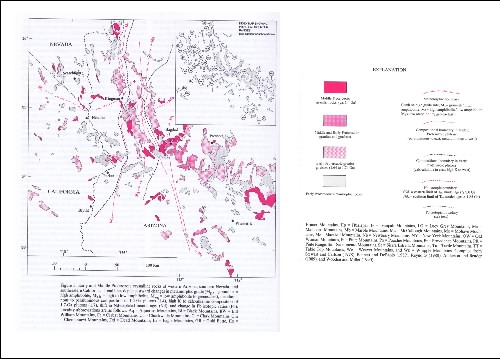
The layered gneisses are metasedimentary and metavolcanic rocks with quartz-rich to feldspathic sandstones and mudstones sedimentary protoliths and andesite and dacitic igneous protoliths (Anderson et al., 1993). The gneisses are generally garnet-siliminatie-biotite and garnet-cordierite-siliminite-biotite metomorphic rocks. The foliated plutons were described as being deformed either pre-kinematic, syn-kinematic, or late-kinematic in respect to the Ivanpah Orogeny (Anderson et al., 1993; Bryant et al., 2001). The lithologies of this group vary from monzogranite to diorites. The third group described by Anderson's group are the anorogenic plutons. The emplacement ages of these rocks are younger than the other groups: 1.42 to 1.4 Ga. The other two groups (the layered gneisses and the foliated plutons) generally yield cystallization ages around 1.7Ga from U-Pb and Pb-Pb dating methods. Anderson et al.,(1993) define the boundary between Mojavia and Yavapai as the sharp transition from 1.7Ga rocks to 1.4Ga rocks. This transition is also marked by a petrological change from metaluminous granites in Mojavia to peraaluminous granites in Yavapai. Of course, the distinct change in depleted mantle model ages changes from 2.0-2.2 Ga in Mojavia to 1.7-1.8 in Yavapai (Bennet and DePaulo, 1987).
Geochemistry of Mojavia:
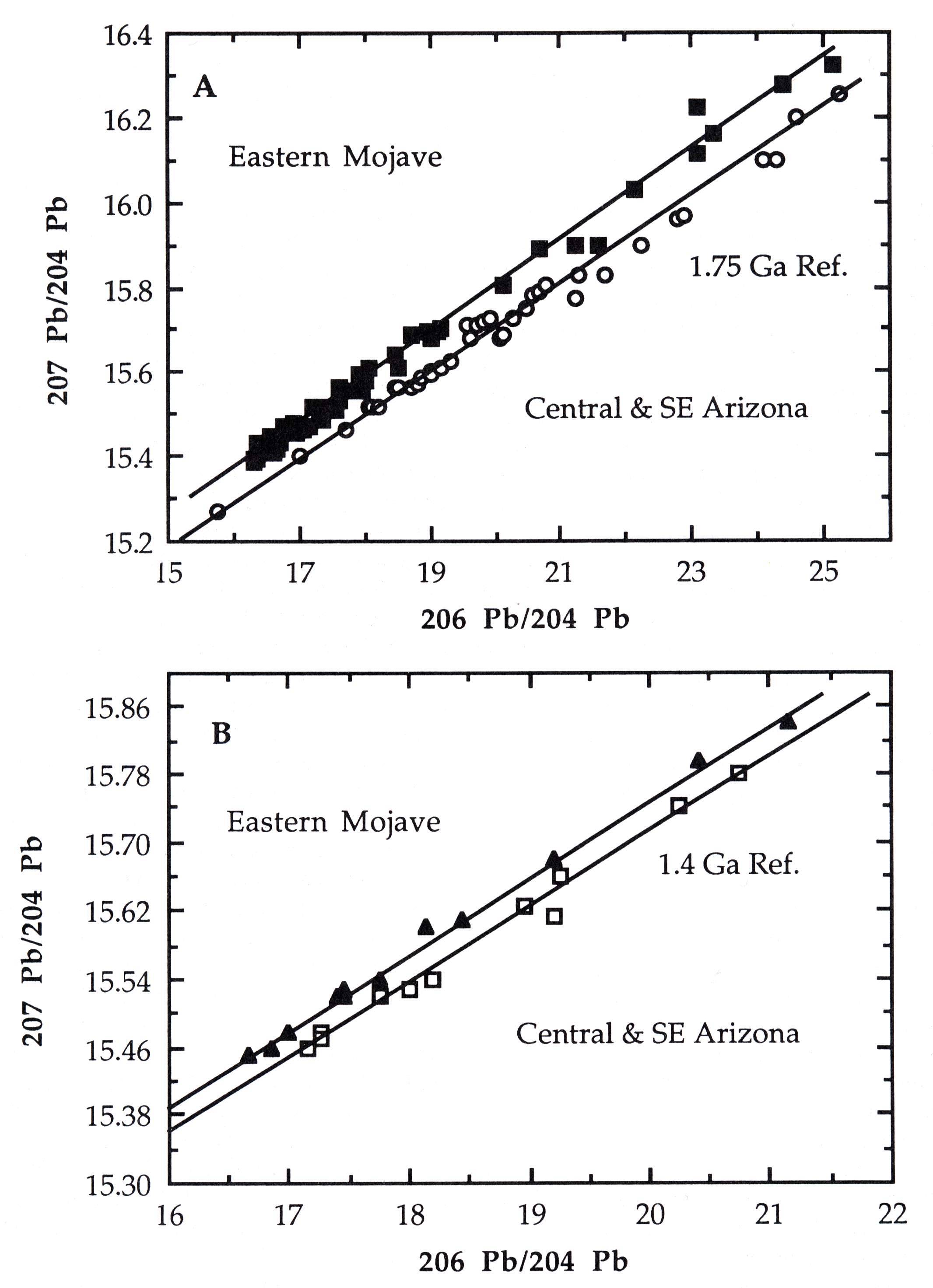
Proterozoic to Tertiary rocks were sampled in varous studies to determine the age of the Mojavia crust which the granitic melts sampled. Initially, Mojavia was found to have TDM ages of 2.0-2.3Ga (Bennett and DePaulo, 1987). Further work by Ramo and Calzia (1998) determined that the crustal ages for Mojavia are older than the former study. They found TDM of 2.1 to 2.6 Ga. Bennett and DePaulo believed that the 2.0Ga + age and the 1.65-1.8Ga crystallization age was a result of mixing Proterozoic mantle wiith Archaen sedimentary material at an ocean island arc. The older dates produced by the work of Ramo and Calzia supports a larger Archaen source component. But, there is no Archaen craton near Mojavia to erode While Bennet and DePaulo have suggested that Mojavia was once part of the northern Wyoming province, Ramo and Calzia(1998) and Condie(1992) believe that the two provinces are not related.
Mojavia: an exotic terrane?
The boundary between Yavapai and Mazatzal provinces has a gradation in TDM, reflecting accretion (Bennett and DePaulo, 1987). The TDM boundary between Mojavia and Yavapai-Mazatzal is sharp by contrast. The TDM in Mojavia is 2.2-2.6Ga, while Yavapai is 1.7Ga. This sharp boundary is reflective of a suture, probably the collision of Mojavia with Laurentia. The Ivanpah orogeny (1.70Ga) is recognized as the collision which accreted Mojavia onto Yavapai and Mazatzal (Condie, 1992). Syn-tectonic fabric and plutonic rocks in Mohavia reflect this collision (Anderson et al., Bryant et al., 2001). The Neodymium work and geology suggests that Mojavia is very different from any cratonic rocks in North America. But where did it come from? Was Mojavia a microcontinent, part of another continent, or an island arc system? Evidence from Proterozoic and Paleozoic formations of a continent attached to the Cordilleran margin suggest that perhaps Mojavia was part of another continent which connected to Laurentia in the configuration of Rodinia. Reconstructions of the Precambrian supercontinent Rodinia try to include this question in their models.