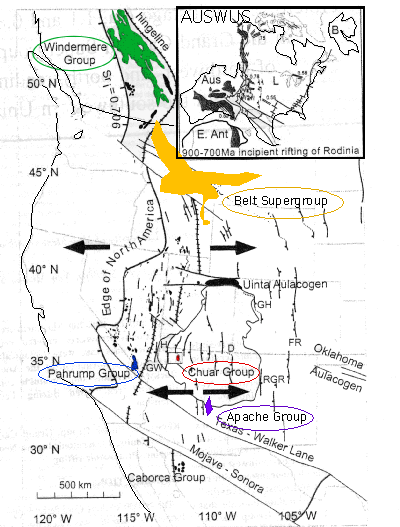
 Map
of Proterozoic rock outcrops (in black and in color). modified from Timmons
et al., 2001. Locations of Apache group from Stewart et al.,(2001), and location
of Belt supergroup from Ross et al., (1991) and Evans, et al., (2000).
Map
of Proterozoic rock outcrops (in black and in color). modified from Timmons
et al., 2001. Locations of Apache group from Stewart et al.,(2001), and location
of Belt supergroup from Ross et al., (1991) and Evans, et al., (2000).Large, thick sedimentary sequences from the Precambrian and Paleozoic are found over the Cordillera. What makes these formations interesting are the fact that they represent two rifting events (where there should be only one ocean opening up) over 300Ma apart. The first extensional or rifting event is around 700-800Ma and the second occurred around 500-600 Ma. The enigma of the Cordilleran miogeocline is a whole wsebsite in itself, and not necessarily an important issue for this topic. While there is continuing debate over the number and ages of rifting, it is certain that something was once fixed to the western margin of Laurentia. I will only focus on how these formations can be used to determine what was on the western margin of Laurentia during the Precambrian. Detailed geochemical and petrologic studies on these sedimentary sequences can help determine what continent was the provenance.
Map
of Proterozoic rock outcrops (in black and in color). modified from Timmons
et al., 2001. Locations of Apache group from Stewart et al.,(2001), and location
of Belt supergroup from Ross et al., (1991) and Evans, et al., (2000).
The main formations used to determine the configuration of Rodinia are the Chuar Group (of the Grand Canyon Supergroup), Apache group, and Pahrump group in southwestern US, the Windermere group in Canada, and the Belt supergroup in Montana.
The Chuar group was deposited no earlier than 742 +/- 6 Ma (Karlstrom et al., 2000b) as well as associated rift sediments. The rift sediments of the Windermere supergroup was also at this time--after 780 Ma (Ross, 1991). The provinence of the Windermere is argued to be from the North American craton (Ross, 1991). So either the source direction was very different from the other groups (discussed next) or Laurentia had already rifted from whichever craton was associated with it. Because the Chuar group is speculated to have been derived from an Australian source (Karlstrom et al., 2000b), it is more likely that the Windermere had a different source direction.
The Belt supergroup was depostied quite earlier before the Windermere and Chuar groups; from 1.4Ga to 1.47Ga (Evans, et al., 2000). U-Pb zircon studies on the Belt supergroup in Montana identified a bimodal Proterozoic and Archaen source (Ross et al., 1991). The ages from the grains were identified to be 1.64 and 1.86 Ga (Proterozoic material) and 2.60-2.64 Ga (Archean source). The sedimentary evidence points toward a southwestern source, yet there is only younger rockers in that direction. Obviously the source was from something that was rifted away. ENd on monazite grains resulted in values of +0.7 to -14.5, and crustal model ages of 2.07-3.36 Ga (Ross et al., 1991).
A detrital zircon study on the Apache group, Grand Canyon Supergroup, and the Pahrump group determined a mix of Proterozoic and Archaen source material (Stewart et al., 2001). The Archaen ages were much older than those from the study on the Belt supergroup. These zircons yielding ages of 2.31 to 3.36 Ga were interpreted to have been derived from the Wyoming province. The "unusual" zircon age of 1.577 Ga is attributed to an exotic source (Stewart et al., 2001).
What continent could have been attached to the western margin of Laurentia and could have deposited these sediments?