SWEAT: South Western US and EastAntarctica
This configuration of Rodinia is based on fitting southwestern United States
with Antarctica and Canada with Austalia. One of the questions that Mojavia
and the Proterozoic and Paleozoic formations brings up is: what is the source
for the exotic Proterozoic and Archaen material? Borg and DePaulo (1994) believe
that the Archaen source is the Miller Range in Antarctica. The TDM
of the proterozoic basement is 2.0-2.2Ga, matching the TDM
determined by Bennett and DePaulo (1987).
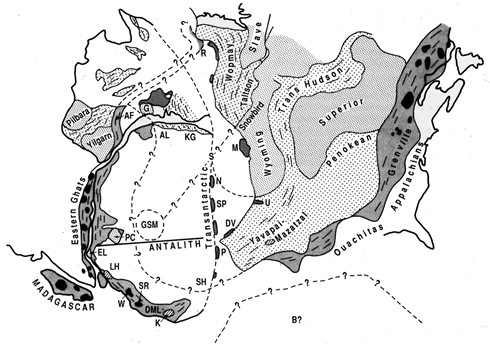 The SWEAT configuration (on the right) was first proposed by Moores (1991).
He used the orogeny that accreted Mazatzal to Yavapai as a Laurentian continuaation
of the Wompay orogony on Antarctica. Also, Moores (1991) suggested that the
Belt supergroup had a depositional source in the Transantarctic Mountains and
that there is perhaps a continuance of the Pahrump group in Patuxent formation
in Antarctica. The main problem with these connections are that they are mostly
speculation and haven't been tested (mainly because it is Antarctica).
The SWEAT configuration (on the right) was first proposed by Moores (1991).
He used the orogeny that accreted Mazatzal to Yavapai as a Laurentian continuaation
of the Wompay orogony on Antarctica. Also, Moores (1991) suggested that the
Belt supergroup had a depositional source in the Transantarctic Mountains and
that there is perhaps a continuance of the Pahrump group in Patuxent formation
in Antarctica. The main problem with these connections are that they are mostly
speculation and haven't been tested (mainly because it is Antarctica).
Australia is matched with Canadain the SWEAT model. Siberia (not shown)
is frequently matched with northern Laurentia in the SWEAT configuration,
while other models have places Siberia next
to Mojavia (Buchan et al., 2001).

Above is the Moores SWEAT configuration (A) compared to an adjusted SWEAT proposed
by Borg and DePaulo(994). This modified SWEAT model has more concrete data supporting
it. TDM from Antarctica are matched with the southwestern
United States. Antarctic terranes are brought down towards Yavapai-Mazatzal
by a long right lateral system. The Miller Range is matched with Mojavia based
on TDM values (they both have TDM
of 2.0-2.2). But recent work by Ramo and Calzia (1998) have found crustal model
ages in Mojavia of 2.1-2.6 Ga, which is significantly older than the Miller
Range. Most of the data supporting the SWEAT model comes from paleorift configurations
and the geology of Antarctica which is poorly known. This model is very hard
to test for these reasons. The other popular Rodinia reconstruction is AUSWUS,
which has more supporting data.