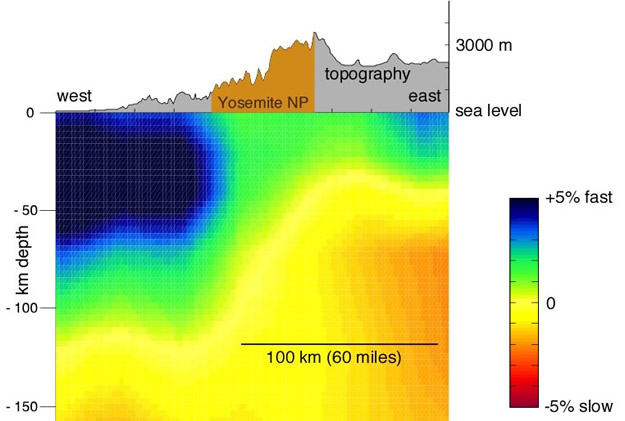
Using the approach above, scientists have made this picture of what is below us here. We see that rocks under the western foothills carry seismic waves faster than those to the east. This could happen if the crust were thicker to the east and the picture was blurry, but other studies show that the crust is thinner to the east. So this means that rocks in the west have higher wavespeeds than the east, probably in the uppermost mantle. Because higher wavespeeds are usually found in denser rocks, we can deduce that there are denser rocks under the western part of Yosemite than the eastern part.
Move your finger over the picture to see the boundaries found by other studies superimposed on this picture.