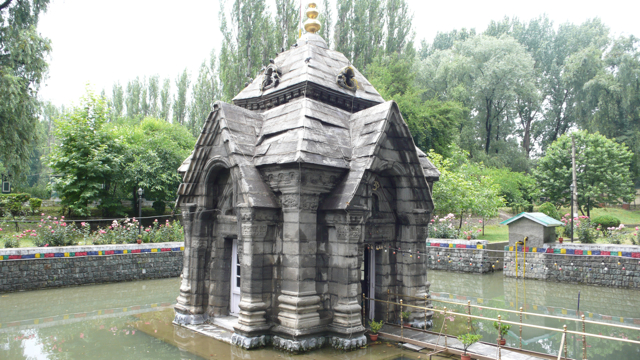
Pandrethan Temple (viewed from the north in June 2009) lies within a square shaped tank to the north of the Jhelum River on the flood terrace, near bedrock. Settlement has caused its lower plinth to be flooded unevenly. Its roofing stones were drawn and photographed in a dislodged state at various times between 1856 and 1908 (see 1903 photo below). The lower roof blocks remain slightly misaligned after recent repairs and the pyramidal capstone has been lost. The temple was not damaged by the 1885 and 2005 Kashmir earthquakes (estimated Mercalli intensities VII).
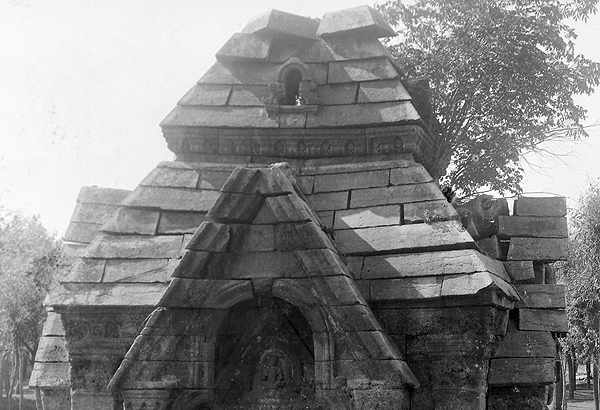
Dislodged roof blocks, Pandrethan 1903 [R. D. Oldham: permission to reproduce this photograph may be obtained from the Director, Geological Survey of India, Kolkata.]
The Shiva temple at Pandrethan (Pandrinton/Padrenton of Hunter, 1881), or Pandrynton (Temple, 1885), at 74.860E. 34.056N) ≈3 km east of Srinagar, Kashmir is believed to have been constructed AD 913-921. It consists of a symmetrical stone structure measuring 5.5 m square aligned N20W with a portal on each side. Its stone-block pyramidal roof is interrupted by an overhanging step and four small windows. Tradition has it that for religious reasons the temple was erected at the center of a pond fed by a natural spring. Kak (1933), however, suggests that the temple was originally constructed in a swamp that has been drained, and that the temple may have been constructed as late as the early 12th century. The temple now tilts at approximately 5° as a result of uneven settlement in the past 1000 years.
Visitors to the temple
In 1665 Bernier (1841) almost certainly visited the temple during his visit to Kashmir with Aurangzeb. He mentions the numerous ruins near Srinagar, but describes in detail only the larger temples in the valley. In 1823 Moorcroft & Trebeck (1841) visited the temple twice. On their second visit on 15 May, Trebeck, in the absence of a boat, swam inside to describe its decorated ceiling to Moorcroft. They were dissappointed to find no inscriptions within the temple. In 1835 Baron Hugel (1845) contented himself with a view from the banks of its surrounding pond, speculating erroneously on Buddhist sculpltures contained therein. In the same year the temple was visited by Vigne (1844) who sketched it. According to Cunningham (1848) Elphinstone visited the temple in 1846 and discovered the interior coated with plaster. Cunningham (1848) had the plaster removed and made a sketch of the internal ceiling, and the exterior setting of the temple. This outside view was reproduced by Fergusson(1867) who repeats Cunningham's speculation that a third overhanging tier of triangular roof may have been lost. That Trebeck noted the large lotus design at the center of the ceiling that was sketched and described by Cunningham, suggests the plastered layer was not complete, or not thick. In 1859 Richard Temple (1887) described and sketched the structure, but his sketches, like those of Vigne were not included in his published accounts. In 1860 Knight (1863), lacking a boat, sketched Pandrethan from the banks of the pond. In 1868 the Pandrethan temple was photographed from the south by John Burke and is one of three views published by Cole(1869) who writes: 'The small village of Pandrethan is situated on the Jhelum, about a mile and a half to the south-east of Srinagar...The Temple is close to the village, and stands in the centre of a tank of water...At the time of my visit, the water was about two feet over the floor of the Temple, and I had to obtain a small boat to enable me and my surveyors to take measurements. The stone ceiling is elaborately carved in bas-relief figures, and it is one of the most perfect pieces of ancient carving that exists in Kashmir...The pyramidal roof is divided into two portions by an ornamental band. The corner pilasters are surmounted by carved capitals, and the pediments of the porches appear to have terminated with a melon-shaped ornament. The ceiling is formed of nine blocks of stone; four resting over the angles of the cornice, reduce the opening to a square, and an upper course of four stones still further reduces the opening, which is covered by a single block decorated with a large lotus'.
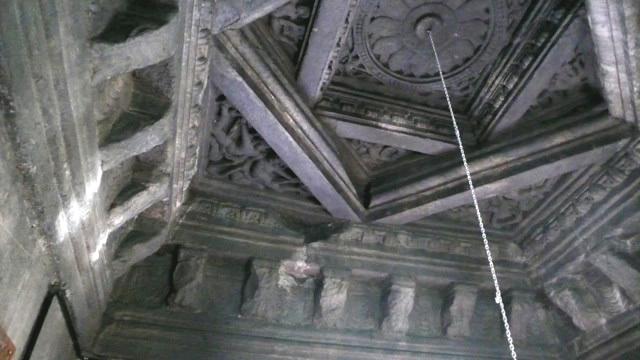
The survival unscathed of Pandrethan's ornately carved ceiling to the present suggests that total collapse of the monument and subsequent reconstruction has not occurred, although one cannot exclude the possibility that the structure was damaged in early historical times and repaired by expert masons.
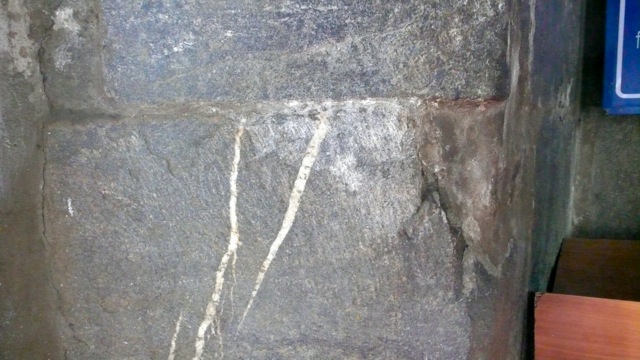
Close up of corner fracture and recent repair to joint between two 30 x 30 x 40 cm limestone blocks forming an internal wall of the temple.
References
Bernier, Francois, Travels in the Mogul Empire, A.D. 1656-1668 . (1891) Trans. I. Brock and revised by A. Constable. pp. 497. Constable & Co., London.
Bilham, R., B. Singh, I. Bhat and S. Hough, (2009). Historical earthquakes in Srinagar, Kashmir: Clues from the Shiva Temple at Pandrethan, GSA Special Publication on Ancient earthquakes. (2009 in the press),
Burke, J., (1868) British Library, Shelfmark: Photo 981/1(40)
Cole, H. H., (1869), Illustrations of Ancient Buildings in Kashmir, India Museum, Published by India museum, W. H. Allen and co., publishers to the India office, 31 pages.
Cunningham, A., (1848) An essay on the Arian Order of Architecture, as exhibited in the Temples of Kashmir, J. Asiatic Soc Bengal, September 1848, 241-327. Doughty, M., (1902), Afoot through Kashmir Valleys, Sands and Co., London. pp 276.
Hugel, C.A.,(1845), Travels in Kashmir and Panjab: Containing a Particular Account of the Government and Character of the Sikhs translated by Thomas Best Jervis, East India Company. J. Petheram, London 1845 pp 423.
Hunter,, W. W. (1881), Gazetteer of India,VIII, 284.
Kak, R. C, (1933), Ancient monuments of Kashmir, India Society, 172 pp. 1971 reprint
Knight, W. H., (1863), Diary of a Pedestrian in Cashmere and Thibet, Bentley, London. pp.385
Moorcroft W. & G. Trebeck, (1841). Travels in the Himalayan Provinces of Hindustan and the Panjab, in Ladakh and Kashmir, in Peshawar, Kabul, Kunduz, and Bokhara from 1819 to 1825. ed H.H. Wilson, J. Murray, London Volume 2, 565 pages
Temple, R., (1887) Diary of a Journey into Jammun and Kashmir between 8th June and 8th July 1859, in Journals kept in Hyderabad, Kashmir, Sikkim and Nepal. Volume 2. pp. 303.
Vigne, G. T., (1844), Travels in Kashmir, Ladak and Iskardo, the countries adjoining the mountain course of the Indus, and the Himalaya, north of Panjab, with map. H. Colburn, London. Vol. 1 pp. 406. 2nd Ed