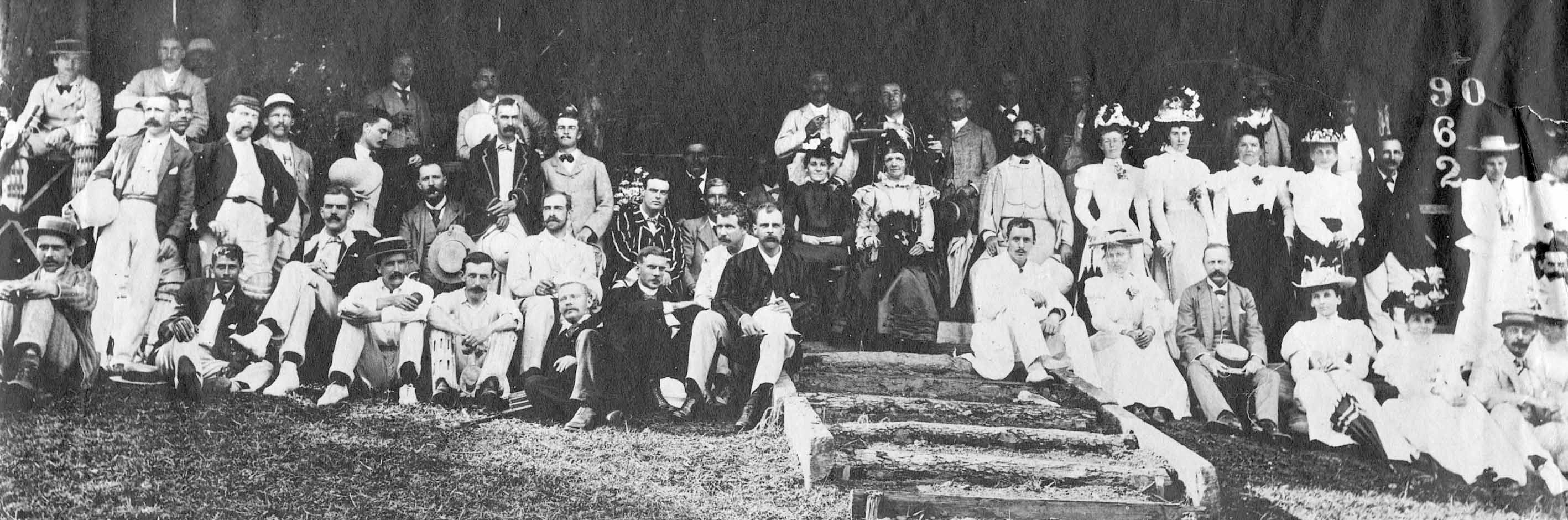
"Sir William Ward was in those days Chief Commissioner of Assam, and the Residencey was proverbial for its entertainments of every kind; no one, indeed could visit the place without receiving at the hands of Lady Ward (top right of stairs seated) some kindness in its best forms, and few ever left it without regret" (from Kabul to Kumassi - Sir James Willcoks). Captain J B Chatterton is famous for an ankle injury that required surgery in 1882. he was retired on half-pay and suffered some ignominity which resulted in questions asked in parliament. It is not clear that this is the man labelled in a note on the back of the photo, as seated on the left balustrade (to the right of Lady Ward) with the chaplain to our left (his right) in this photo.
Click on photo for an enlargement
The Cricket Pavillian in front of which this photo was taken was made of wood and survived the 1897 earthquake.
"I started off alone to try and find my father and mother, who were out driving. As I went along everywhere it was the same—not a house standing and people rushing about, wives looking for their husbands, parents looking for their children, every one stricken with terror, no one knowing whether those belonging to them were dead or alive. I then rushed on to the cricket ground, where I found a crowd of people collected. They had all been told to go there, because every one expected another shock, and that was considered the safest place. There were some who had been ill in bed and had rushed out in their night gowns with bare feet, and some half-dressed, some crying and some in hysterics,—everything in the wildest state of confusion. And then the rain came and it poured. This seemed extraordinary, because before the earthquake there was not a cloud to be seen, and five minutes afterwards we were surrounded with cloud and mist . Then every one started looking for shelter, and half of us went to the cricket pavilion which was built of wood and had stood, and half went to a row of thatched sheds which were usually used as a bazaar; they were also wood." an eyewiness account of the 1897 earthquake