 |
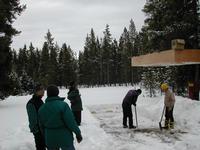
By the time Rob and I arrived, it was noon, and Richard had been working with the
others to clear
the snow away from the area needed for the wooden foundation. (The foundation is not actually floating in mid-air, it's
suspended from a crane out of the picture to the right.) Susumu Nakamura
and Hideyuki Fujii, who built the container, are
hacking away at ground that's frozen solid, to
get the foundation as level as possible.
|
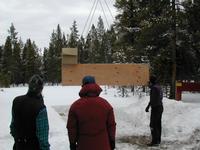 |
Lowering (or lifting)--they did this several times over to get it just right.
|
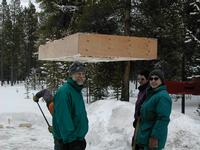 |
Perspective's a bit odd here, hard to see the crane.
|
 |
Once they decided that 1/4" over 8 feet was good enough, they started to
move the container (built by the Japanese) with the instrument (built by the
Germans) inside.
|
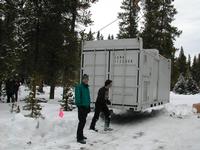 |
I wasn't getting anywhere near where this thing was swinging. Seeing it
up close like this gives a whole new appreciation for large equipment
operators like the guy who ran the crane.
|
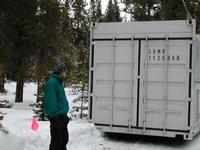 |
They had a scale on the crane: it weighed 18,600 pounds! (That's about
8,400 kg, compared to about 324 kg for the AMSR that's going to be on the
Aqua satellite launched later this year (cross yer fingers), or 1,100 kg
for the entire instrument payload on Aqua.)
|
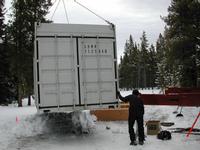 |
As if having it level wasn't good enough, they must have lifted it ten
times to make fine positioning adjustments.
|
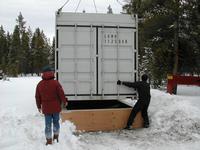 |
We're talking fine positioning.
|
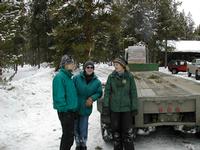 |
Meanwhile, Richard and I visited with Amy, our local USFS rep.
|
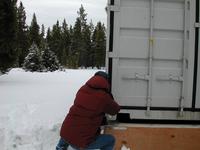 |
Did I mention the fine positioning?
|
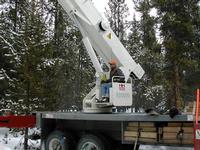 |
That crane operator was amazing. When he was finished, he asked us how
much the instrument was worth, a million bucks? (We didn't really know.)
He said he was sure he'd never lifted anything that expensive before.
(Glad he knew what he was doing!)
|
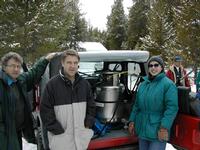 |
Peter and Ralph Zimmermann (the instrument engineers) and me, with our friend, R2-D2 (the dewar with
the liquid Nitrogen) softly hissing in the Jeep. The guys who loaned us
the dewar told us, "make sure
it keeps hissing, if it stops, run like hell!" (Oh, yeah, thanks, just
what I needed to hear. Whaddaya mean "make sure it keeps hissing"? Like
I can really do anything about it!) That morning I had asked my husband, Hans, if
there's anything special I needed to know about transporting this stuff.
He told me, "Nah, there's nothing to it, these containers are fool-proof,
you can't screw up." I asked him if was OK to put it on its side if it
didn't fit upright in the Jeep "DON'T DO THAT! It'll freeze the pressure
relief valves!" (Yikes! So much for fool-proof. So I'm supposed to be
born knowing not to tip over pressurized liquid Nitrogen dewars? Sheesh!)
|
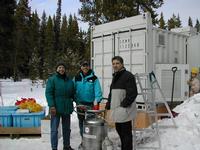 |
Boy, are we glad to be rid of R2-D2, hissing away. Too bad Rob missed the
shot where he opened the escape valve and gave Ralph and me a cold spray.
(Gee, whiz, Rob, give us a break, give a warning or something when you
start opening valves!)
|
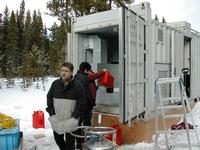 |
Fillin' 'er up. This container is amazing, a lot like those newfangled
hybrid cars, runs on unleaded, or electric. We didn't have power lines to
the site,
yet, so we had to live with fumes for a while, as much as we hated to
stink up the forest.
|
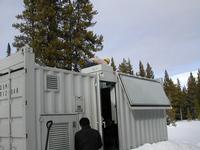 |
The radiometer is mounted on a big scissors-jack in the middle of the container.
|
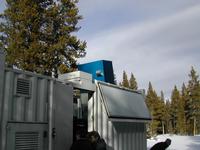 |
It's the big blue box.
|
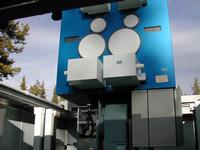 |
The view from inside the container.
|
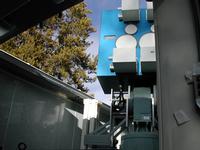 |
The antennas are the round things covered in styrofoam.
|
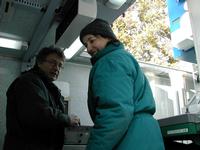 |
There's not much room inside. Reminded me of those old NYC apartment
jokes: "my apartment is so small, you have to go outside to change your
mind..."
|
 |
Richard and Ralph waiting outside. Notice how much snow there is, and
this is the beginning of the winter!
|
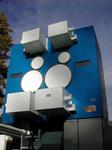 |
The silverish boxes are the source for the hot load.
|
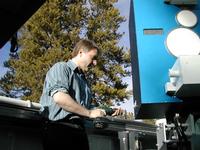 |
Ralph offered to take off the side panel so the rest of us could see inside.
|
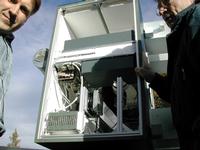 |
It's a lot simpler than I had expected. Of course, that's probably
because Peter was good at explaining it all.
|
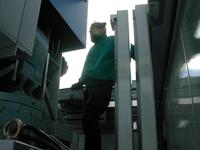 |
Richard, waiting to take a look inside. Now we just have to be patient
and wait for the calibration before we
start pushing buttons. (Hey, Rob! Do us all a favor and ask before you push any!)
|